

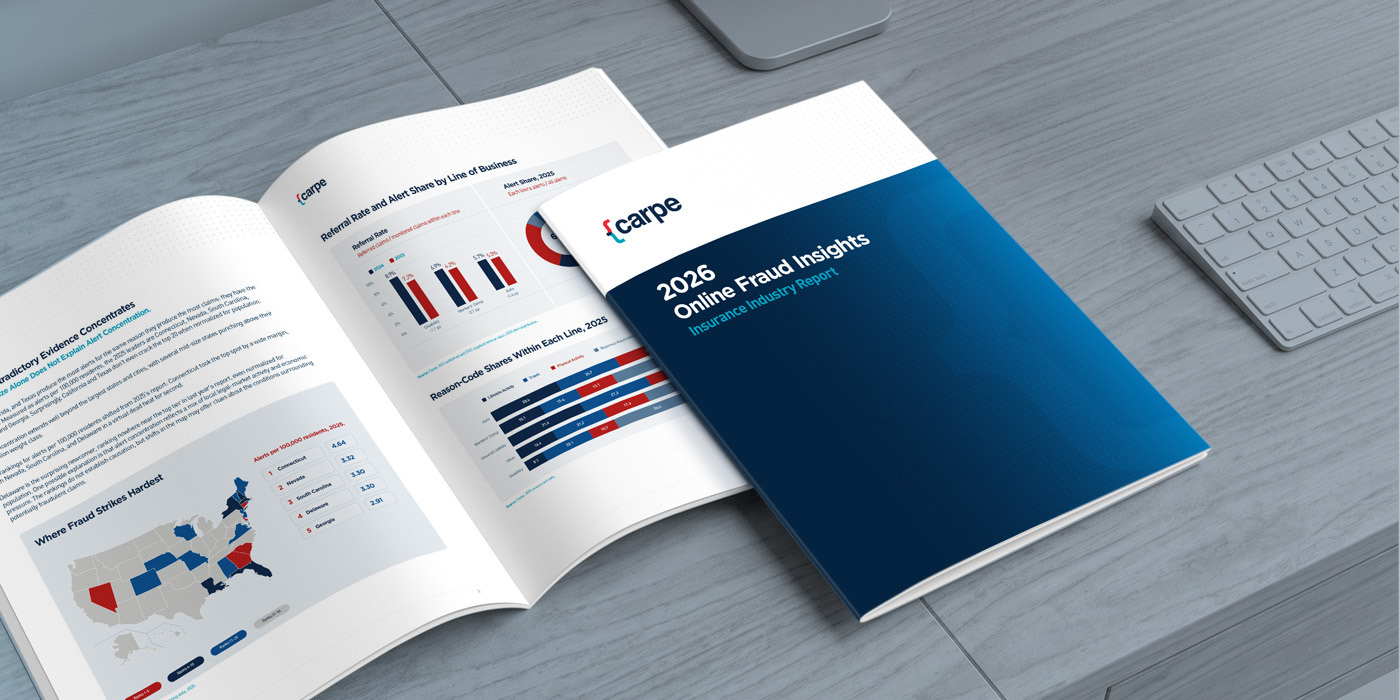
Fraud Referrals Declined and Projected Cost Savings Increased in 2025, Carpe Finds
An analysis of Carpe’s 2025 injury-claims fraud data finds fraud referral rates declined by all lines of business in 2025, while the modeled value increased materially.
Key Findings:
-
Carpe fraud report finds fraud referral rates declined across disability (-1.7%), workers’ comp (-0.7%), and auto (-0.4%) from 2024 to 2025.
-
Carpe reveals its modeled value of contradictory alerts increased from $230.6 million in 2024 to $263.8 million in 2025 across its platform.
-
Connecticut, Nevada, South Carolina, Delaware, and Georgia rank as the top five U.S. states with the highest alert concentration when measured as alerts per 100,000 residents.
-
About 36% of referrals involving contradictory alerts surfaced within the first two months after the reported loss, a pattern that remained stable year over year, at about 35% in 2024.
SANTA BARBARA, Calif. [BUSINESSWIRE], Oct 7th, 2026 - Carpe today released its second annual Online Fraud Insights Report, analyzing insurance claims fraud activity across its platform in the United States. The report found that from 2024 to 2025, fraud referral rates declined across disability (-1.7%), workers’ comp (-0.7%), and auto (-0.4%). Carpe also found its modeled value of contradictory alerts increased from $230.6 million in 2024 to $263.8 million in 2025 across its platform, based on reported outcomes from carriers. The data suggests that even as the frequency of fraud may be decreasing, the severity and cost of those claims continue to drive substantial losses for insurers and claimants.
“AI is helping insurers identify which fraud alerts need further evidence review and which don’t, reducing both the time spent on analysis and increasing the value of their efforts,” said Tom Rasmussen, VP of Claims Product at Carpe. “The decline in referral rates across three major lines is an encouraging sign, but it does not mean the risk is going away. Fraud tactics are evolving quickly, and the data shows that where and how suspicious activity appears can shift just as fast. Carriers need to assess claims early and continuously, so they find contradictory evidence before it drives unnecessary payouts or costly litigation.”
Key findings from the report include:
-
The highest insurance fraud is not in the most densely populated regions: Connecticut, Nevada, South Carolina, Delaware, and Georgia ranked as the top five U.S. states with the highest alert concentration when measured as alerts per 100,000 residents. Delaware broke into the top 5 in 2025, ranking nowhere near the top in last year’s report, potentially due to a mix of local legal-market activity and economic pressure.
-
About 36% of referrals involving contradictory alerts surfaced within the first two months after the reported loss, a pattern that remained stable year over year, at about 35% in 2024. Carriers must assess early and often to ensure contradictory evidence is flagged before it can drive up claim severity or litigation costs.
-
Facebook remained the largest source of social media evidence, accounting for 60.5% of contradictory flags, more than Instagram (13.8%), LinkedIn (7.8%), TikTok (3.2%), and X (0.3%) combined.
-
Disability had the highest claim referral rate at 7.2%, ahead of workers’ comp at 6.2% and auto at 5.3%, even though auto generated 60.9% of all alerts.
-
Claimants ages 35 to 44 had the highest number of fraud alerts, at 25.2%, indicating that this group produces the most evidence of insurance fraud.
For insurers, the report findings show that potentially contradictory evidence is not confined to one claim type, location, platform, or point in the claim lifecycle. Effective fraud detection requires a layered approach: assess claims early, continue monitoring as they develop, search across social and non-social sources, and tailor reviews to each line of business. As fraud becomes harder to detect and digital evidence easier to manipulate, claims teams need faster, more defensible ways to surface meaningful signals without adding manual work. Carpe’s AI-native Claims Solutions, powered by the Claims Reasoning Engine, provide a proactive, evidence-backed approach that helps insurers uncover risk earlier, reduce operational burden, and focus investigative resources where they matter most.
This report analyzed Carpe’s findings from 2025, based on continuous monitoring of open injury claims across auto, workers’ comp, general liability, and disability lines. This quantitative data analysis, paired with qualitative insights from internal subject matter experts, identifies trends, patterns, and anomalies in fraudulent behavior related to injury claims. As this is the second annual report, Carpe has compared this year’s findings to historical data to show which patterns are holding, which are shifting, and where the trend lines point next.
About Carpe
Carpe gives insurers the shortest path from data to decision. The company's AI-native solutions transform online data and public records into decision-ready intelligence for fraud detection, claims management, and underwriting. Carpe serves leading insurers with products designed for real insurance workflows, helping teams evaluate risk, act faster, and make more confident decisions. Learn more at www.carpe.io.
Media Contact
Hallie Criste, INK Communications for Carpe
Source
Carpe Newsroom
Related Resources
Why AI fraud tools could cause claim risks
Carpe VP of Product Tom Rasmussen explains why black-box fraud scores create operational and legal risk when claims teams need defensible evidence.

Carpe Data urges industry-wide collaboration to stem AI-driven insurance fraud
Carpe Data calls for coordinated industry response to counter increasingly sophisticated fraud tactics powered by artificial intelligence.

Artificial Intelligence at Allianz: Two Use Cases
Emerj examines how Allianz deployed agentic AI to automate low-complexity claims and machine learning to flag potential fraud, both with measurable operational gains.
See Carpe on Your Own Book
A short conversation and a tailored walkthrough of the Carpe solutions that match your line of business.
Talk to An Expert